The nautiloid had become a palimpsest of possible outcomes for one Baldur's Gate 3 player, every fleshy corridor baked with choices that shifted depending on ancestry, background, and class. Agent_Gentleman, a veteran of countless restarts, had long assumed the introduction held no further secrets. Then a single dice roll cracked that assumption like a hammer tapping a hidden hollow in a stone wall.
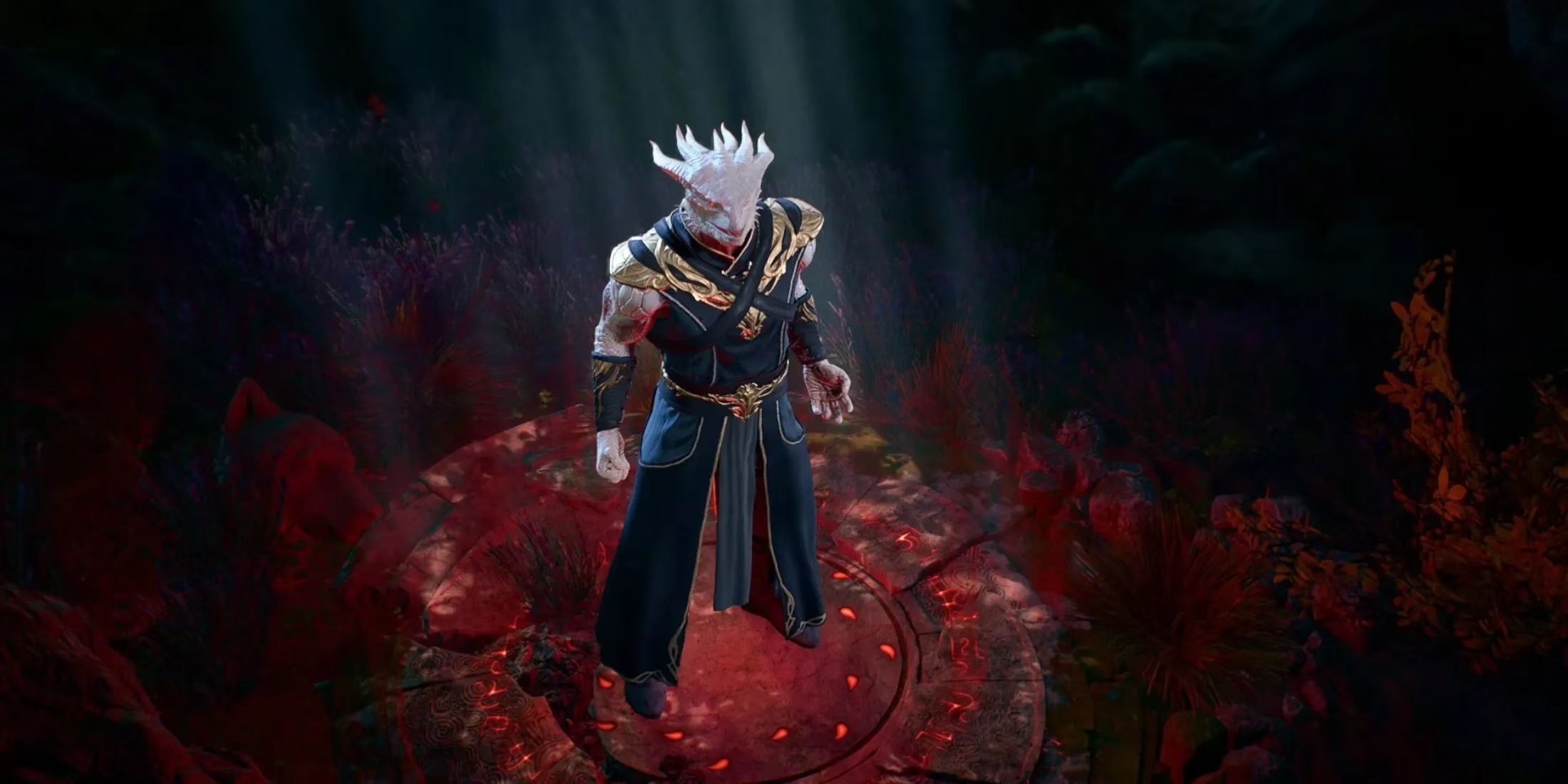
During the opening aboard the mind flayer ship, most players free Shadowheart from her pod by using a rune, magical force, or a few class-specific tools. Some choose to leave her, and the game acknowledges that later with altered dialogue. But a Barbarian approaching the same cramped, bioluminescent chamber stands before the pod like a blacksmith sizing up a warped hinge—not with a spellbook's patience but with the quiet arithmetic of leverage. The game offers a unique roll: rip the pod door clean away. Agent_Gentleman noticed it only after what they described as so many hours in the game, though they did not confirm how many restless avatars had passed through that same vessel.
Another player in the discussion added a fine-grained detail: the Barbarian gets electrocuted while tearing the door free. The small shock is not a punishment so much as an immersion pulse, a reminder that flesh and metal on a nautiloid do not yield without complaint. It also makes the moment feel less like an invisible dice calculation and more like a stunt chosen by a body rather than a menu. 🎲⚡
That discovery opened a wider conversation about the unwritten rule of playing a Barbarian in Baldur's Gate 3: if force can solve a problem, force should solve the problem. Players traded stories of dialogue trees bypassed by a thrown object, a shattered obstacle, or a well-placed intimidation. The class detail is one of many trapdoors hidden beneath the floorboards of Larian's reactivity; only the right weight reveals the seam.
The usual approaches to Shadowheart's pod can be contrasted like this:
| Method | Typical Requirement | Result |
|---|---|---|
| Interface with the pod's rune | Ordinary interaction | She is freed |
| Class-specific magic or psionics | Spellcasting or plot triggers | She is freed with unique dialogue |
| Barbarian-specific ripping | A unique Strength-based roll | Door tears away, caster is zapped |
| Leave her behind | No roll | Later encounter changes |
That table, of course, flattens a world where even the order of these choices can ripple outward. But it shows why a single class can turn a familiar hallway into a different kind of stage.
For most players, the pod scene lasts only a few seconds, a thin threshold on the way to the beach. For Agent_Gentleman, it became a small proof of how Larian embeds entire identities inside a single roll. A Sorcerer sees a magical solution where a Rogue might see a mechanism, while a Barbarian sees a door and asks why it still exists. The hidden check does not broadcast itself in a tooltip; it waits inside the character's class tags and the player's willingness to choose the loudest route.
Larian has kept the game breathing into 2026 with hotfixes, and the confirmed additions of crossplay and photo mode have long since become part of the everyday landscape, although the studio remains in the early stages of two new RPGs. Even so, players like Agent_Gentleman continue to mine the original for small seams. The nautiloid's shadowy pod chamber is no longer just a tutorial beat; it is evidence that Baldur's Gate 3 behaves less like a static script and more like an old house with fresh rooms appearing when someone tries a new key. Each run becomes a different interrogation of the same spaces, and sometimes the answer is not a spell or a sword, but the simple, shocking, muscle-bound refusal to treat a door as a door.