There's nothing quite like the crackle of magic in your veins or the weight of a well-timed sword strike. I've been chasing that feeling for years, and even now in 2026, the best fantasy games still pull me back into worlds where combat isn't just a system—it's a story. Over the last decade, I've bounced between turn-based tactics, flashy action, and methodical RPGs, and every one of them taught me something new about what it means to fight. Here's my tale, told through the combat systems that defined my love for the genre.
Stepping into the Void with Dishonored 2
My affair with immersive sims started in the rain-slicked streets of Dunwall. The moment I blinked behind a guard and choked him out, I knew Dishonored 2 was special. It wasn't just about the sword and crossbow—the real thrill came from chaining supernatural powers. I'd toss a spring razor into a crowd, freeze time to yank a bullet from the air, then release it back at the shooter before he even knew what happened. Corvo and Emily gave me two completely different toolkits; Emily's Far Reach let me drag enemies into my blade, while Corvo's possession turned a rat into the deadliest infiltrator. Even in 2026, I find new ways to break those encounters.
The Classic Heart of Dragon Quest XI
Sometimes you just want to trust a crystal-clear turn-based loop. 🔥 Dragon Quest XI didn't reinvent the wheel, and that's exactly why I fell for it. Each battle was a quiet dance: buff the hero, debuff the slime, then unleash a Pep Power that made the screen shake. The skill trees let me build a thief who could crit like a freight train or a mage who never ran out of MP. What amazed me, revisiting it just last year, is how that simplicity hides a mountain of depth—every status effect matters, and the party synergy feels like catching up with old friends.
Real-Time Sparks in Final Fantasy VII: Rebirth
I'll admit, I was nervous when Final Fantasy VII: Rebirth started throwing real-time slashes at me. But the ATB bar flashed on screen, and suddenly everything clicked. Cloud would strike to fill the gauge, then I'd pause the chaos, take a breath, and pick a spell. It was the original game's DNA woven into a live-action brawl. Each character brought their own rhythm: Tifa's combos charged lightning-fast, while Barrett soaked up hits and filled his bar from a distance. 🗡️ That blend of planning and reflex made me feel like a true mercenary, and it's a system I still boot up when I need a hit of nostalgia.
Devil May Cry 5 and the Pursuit of Style
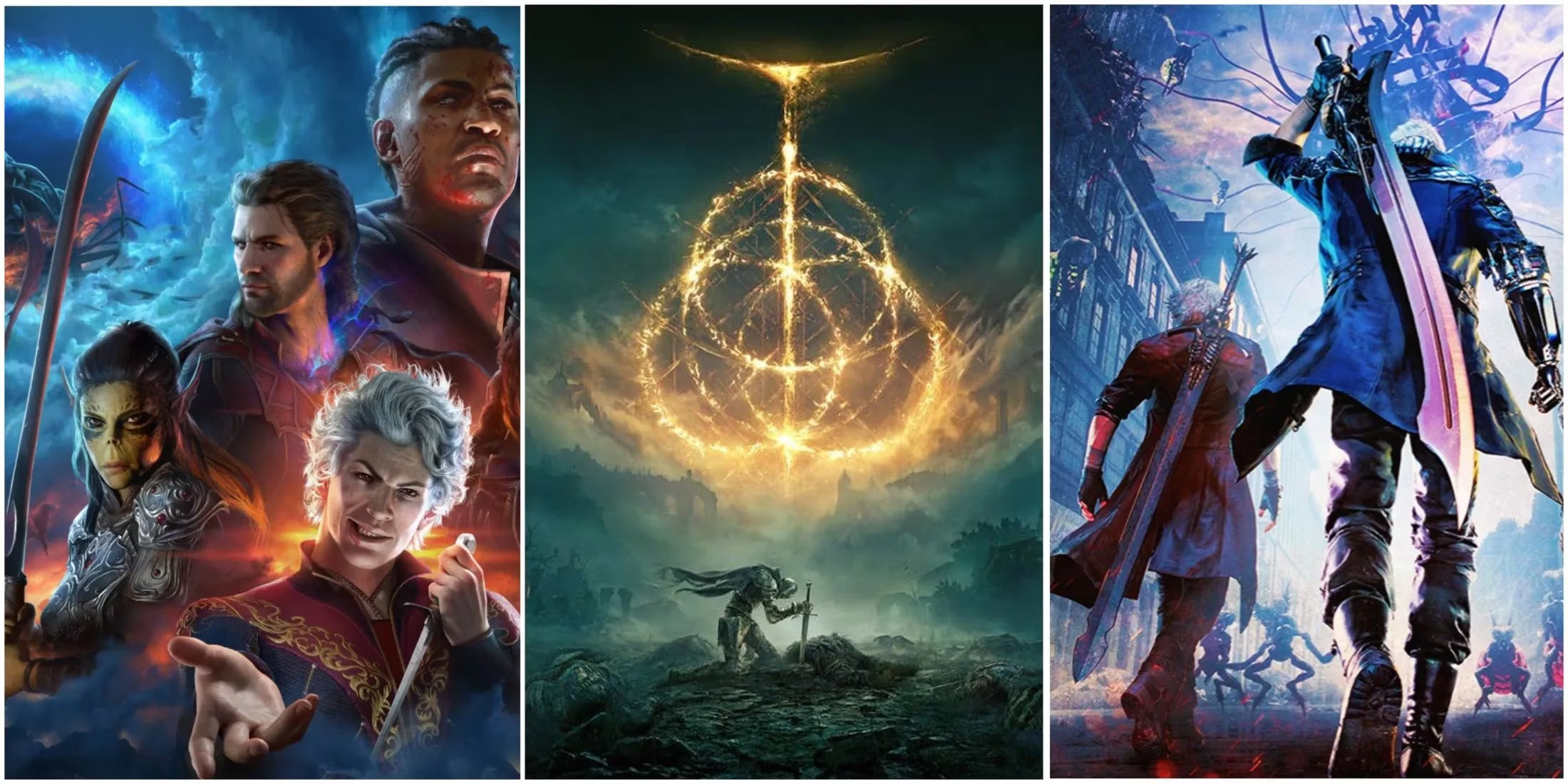
There's a moment in Devil May Cry 5 when everything goes silent except the chiming style meter, and you realize you're not just surviving—you're performing. I'll never forget the first time I swapped through Dante's four styles mid-combo, juggling demons with ebony and ivory before smashing them with a motorbike-sword. It was like conducting an orchestra of destruction. Nero's robotic arm added a wild card, and V's remote-control familiars forced a completely different cadence. Mastering even one character took months, but that SSS rank still gives me goosebumps in 2026.
Prepping for Glory in Monster Hunter: Rise
No game drilled the value of homework into me quite like Monster Hunter: Rise. 🐉 Before every hunt, I'd stare at my inventory: fire weapon, water weapon, antidotes, traps. Then I'd charge a Magnamalo, learn its tail swipe the hard way, and finally dance around its rage to break a horn. The loop never got old—carving materials for a new piece of armor felt like a genuine promotion. Even now, when someone says "dragon," my mind goes straight to the wirebug swings and the roar that signals my next upgrade.
Metaphor: ReFantazio's Double Life
Atlus took me to a world where combat identity was literally a mask. Metaphor: ReFantazio gave me the Press Turn system I loved in Persona, but with an Archetype twist. I could make my protagonist a healer one battle and a sniper the next, carrying over skills that shattered the usual class boundaries. Exploiting a monster's fire weakness to steal an extra turn felt strategic, but the real joy was creating bizarre combos—like a merchant who summoned thunderstorms. 💠 It was weird, flexible, and completely my kind of chaos.
The Dance of Elden Ring
I still remember the Tree Sentinel. My first ten deaths were a lesson in patience; the eleventh was a victory that defined my year. Elden Ring refined the Soulslike into a brutal, elegant waltz. I'd circle a boss, dodge a world-ending slam, and slip in a single jumping heavy before rolling away. Builds were limitless: my first run was a frost-wielding samurai, the second a pyromancer who never touched a blade. Every encounter demanded I read the enemy like a book, and in 2026, that demand still feels like pure respect for the player.
Baldur's Gate 3 and the Sandbox of Chaos
If Dungeons & Dragons is collaborative storytelling, Baldur's Gate 3 is that story set on fire—literally. One moment, my rogue was sneaking for a critical backstab; the next, my druid wild-shaped into an owlbear and crushed a goblin barrel, igniting the whole room. 💥 Larian's adaptation of 5th edition rules made every surface a weapon and every shove a potential kill. I could multiclass into a sorcerer-paladin who smites with metamagic, or talk my way out of a fight entirely. The magic items alone could rewrite a battle, and years later, my friends and I still debate our wildest tactics.
From Dishonored's teleporting chaos to Baldur's Gate's tactical madness, these games taught me that combat isn't just about winning—it's about expression. In 2026, their combat systems remain masterclasses in design, and I'm grateful for every scar and saved kingdom along the way.