In the sprawling world of Baldur’s Gate 3, idle moments at camp can lead to surprising discoveries. One patient adventurer, waiting for their party to gather, decided to test the very fabric of the game’s physics by stacking an improbable tower of crates. The result was a dizzying aerial view that peeled back the curtain on Act 3’s Lower City in all its low-poly glory. What started as a whimsical way to pass the time quickly transformed into a miniature exploration of level design, collision boxes, and the hidden dimensions of Larian Studios’ masterpiece.
Stacking objects is a time-honored tradition in many RPGs, but few players have pushed it to such extremes. The climber, sharing their feat on Reddit, spent an untold amount of time dragging 76 wooden crates from their inventory and carefully placing each one directly on top of the last. No cheats, no mods—just patience and a borderline obsessive commitment to seeing what lay beyond the usual sightlines. By the time they reached the summit of what they humorously dubbed “Mount Boxerest,” the campsite’s modest docklands setting had been replaced by a sweeping vista that would make any urban planner envious.
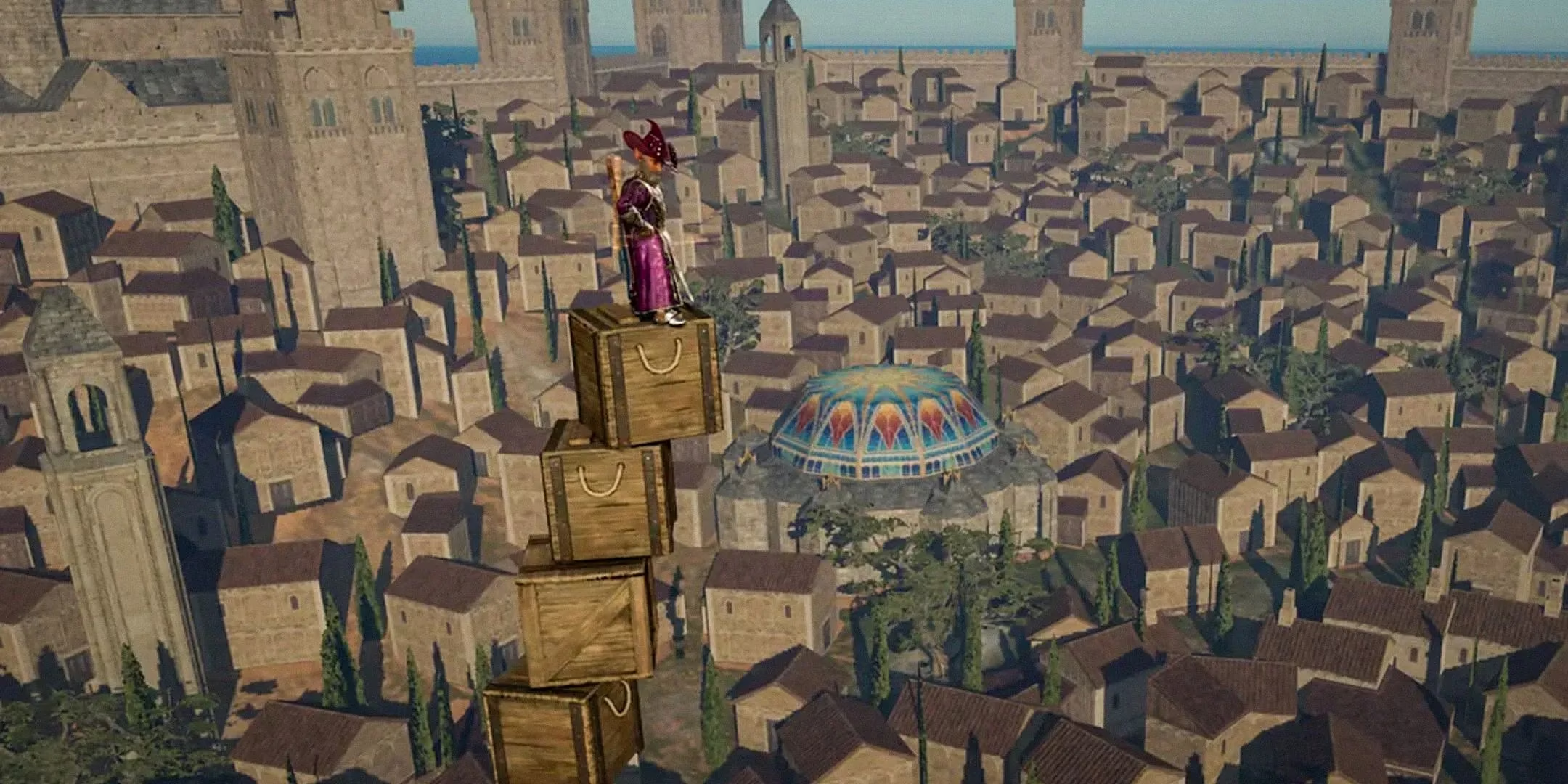
From this improbable vantage point, the entirety of the Lower City spread out like a meticulously designed diorama. Row upon row of miniature homes and shops huddled together, their simplified geometry creating a patchwork of rooftops that stretched all the way to the colossal city walls. Right at the centre, the ornate rooftop of Sorcerous Sundries stood out clearly—a landmark that usually towers over the player but now appeared as just another piece in the puzzle. The scene underscored the jaw-dropping scale of Act 3, a segment of the game already known for its density and verticality, but rarely witnessed from such an unorthodox angle.
Perhaps even more intriguing than the view itself was the realization that there appears to be no hard height limit enforced by the game engine. The player noted that at times the camera would lock in place, refusing to pan further, but a slight wiggle of the controls would reset the view and allow the ascent to continue. Even at 76 crates high, they could glimpse the telltale blue void beyond the map’s boundary, hinting that even greater (or more bizarre) heights might be attainable. This discovery adds a new layer of creative freedom for the community, who have already exploited object placement in BG3 for everything from building bridges to crafting improvised barricades.
The accomplishment evokes memories of another celebrated box-stacking saga—the legendary “Box Ladder” constructed by Critical Role’s Matt Mercer during a live Dungeons & Dragons session. Yet where Mercer’s ladder was a theatrical response to a dungeon puzzle, this in-game tower serves a more introspective purpose: it reveals the precise location of the player’s camp relative to the city. Before the climb, most adventurers assumed their temporary home was somewhere vague along the Sword Coast’s docks. Now, with this slightly cursed aerial photograph, the exact coordinates are laid bare—just a stone’s throw from the water’s edge, tucked against the perimeter that normally remains just out of frame.
How the Climb Unfolded
For anyone inspired to attempt their own record-breaking stack, the process is deceptively simple:
-
Gather crates – Raid your camp stash and collect every wooden container you can find. Strong characters have an advantage here.
-
Place with care – Drop a crate, then carefully position yourself on top. Open your inventory again, drop the next one, and repeat.
-
Wiggle the camera – If the perspective locks, gently rock the control stick or mouse to force the engine to recalculate.
-
Climb until satisfied – Or until you run out of crates, whichever comes first.
There are no loading screens, no invisible walls pushing you back—only the quiet thrill of inching higher while wondering if a guard pigeon will report you for violating some obscure building code.
A Testament to Player Curiosity
What makes this endeavor so endearing is how it reflects the enduring spirit of exploratory play. Long after the main questlines have been conquered, Baldur’s Gate 3 continues to reward those who poke at its boundaries. The low-poly cityscape seen from above is not meant to be scrutinized up close, yet the game world holds together admirably, never once crashing or glitching in a way that would break the illusion completely. It’s a love letter to the developers’ dedication and a reminder that even the most polished digital realms have cracks worth peering into.
The player behind Mount Boxerest remains anonymous, but their legacy is already inspiring others to experiment with everyday objects. One can imagine an arms race of sorts: who will be the first to reach 100 crates? Will someone discover a way to stack items into the starry sky that hangs over the camp at night? The possibilities feel as infinite as the blue void beyond the walls.
In a game filled with mind flayers, ancient gods, and world-shattering choices, sometimes the most memorable adventures involve nothing more than a pile of boxes and the simple question: “What if?”