I logged into Baldur’s Gate 3 on a lazy Monday afternoon in 2026, expecting the Sword Coast to feel a little emptier after nearly three years. To my surprise, over 50,000 adventurers were already there, picking their way through quests, squabbling with companions, and rolling dice. The game hummed with the same chaotic energy it had at launch — only now, it’s been supercharged by something that feels almost magical: a modding community that just won’t quit. It’s wild, really. Back in 2023, Larian rushed the game out early to avoid getting swallowed whole by Starfield, and look where we are now.
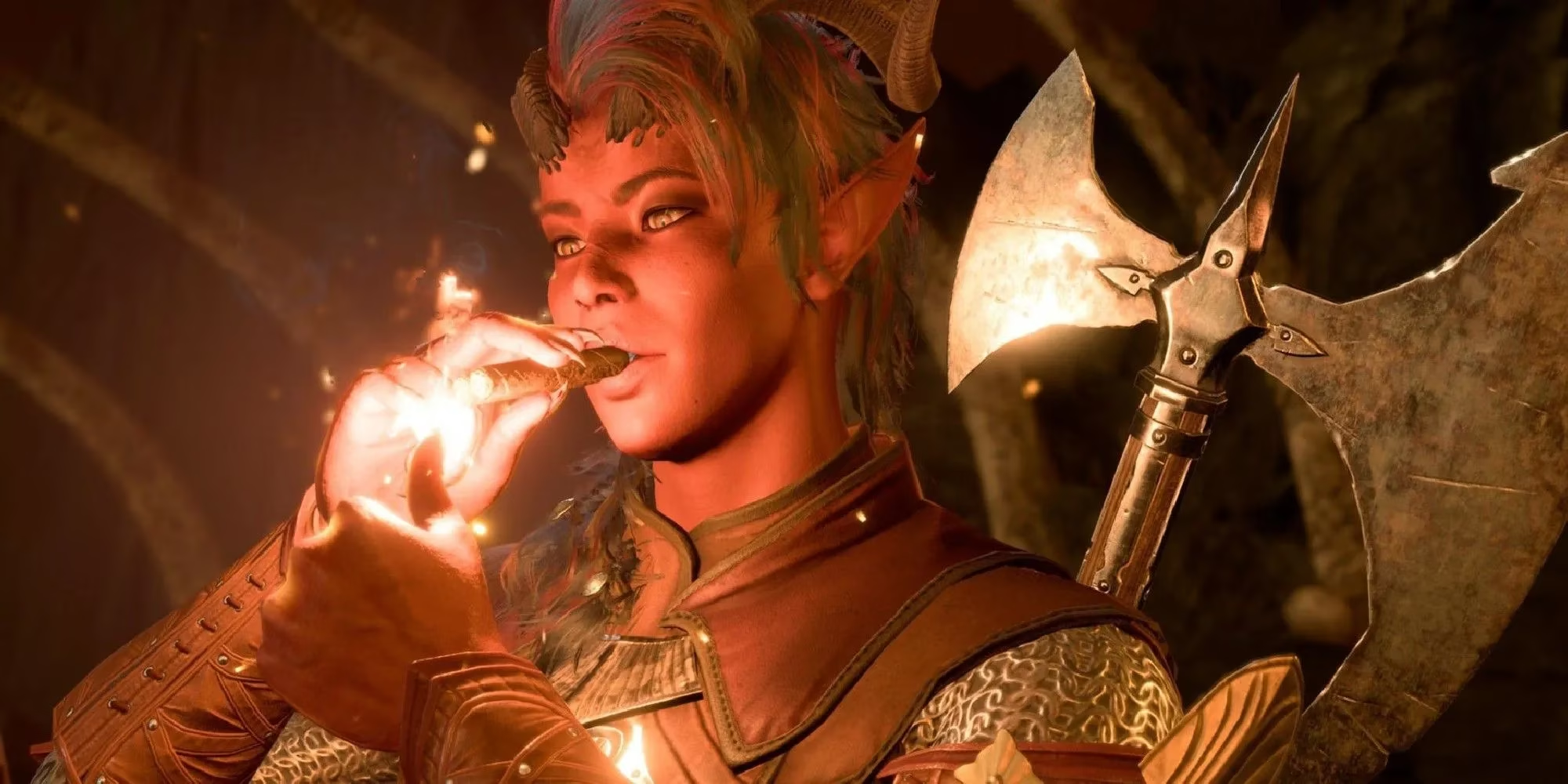
I still remember the collective gasp when Baldur’s Gate 3 left early access and immediately shot to a peak of 875,000 players. It cleaned up at every awards show, snatching Game of the Year like it was always meant to be. You’d think a crunchy cRPG would settle into a quiet niche by now, but nope — the numbers tell a different story. Larian Studios’ publishing director Michael Douse revealed a while back that daily active users jumped by 20 percent year-on-year, with daily peak concurrents rising by 3 percent. And that trend? It’s only deepened. Today, as I write this, a mid-week lull still means tens of thousands of people are romancing Shadowheart, betraying Astarion, or trying yet another Honour Mode run.
The engine humming beneath all this longevity is, without a doubt, mods. Official mod support dropped for PC in September 2024 and for consoles a month later, and I swear the game grew wings overnight. Larian shared that more than 40 percent of players now use mods, and you can feel it in every corner of the community. Think about Skyrim — honestly, that game’s secret sauce was always the modders who refused to let it age. It’s been over a decade and Skyrim still pulls in 20,000 players on Steam on any given day. Baldur’s Gate 3 is tapping into the same vein, and it’s a beautiful sight.
Mods here aren’t just about slapping a new coat of paint on your dice (though I do love my sparkly purple D20). They range from tweaks that tweak lighting and UI, to full-blown overhauls that add subclasses, playable races, and even entire D&D sourcebooks worth of mechanics. I’ve seen mods that weave in new origin characters with voice acting, companions who react to your choices like they’ve always been there, and quest arcs that feel straight out of a tabletop campaign. The replay value of vanilla Baldur’s Gate 3 was already absurd — the number of branching paths could make your head spin — but layer on a carefully curated mod list and suddenly you’re playing a different game entirely. You know what’s crazy? I’m on my seventh playthrough and I just discovered a hidden grove that only appears thanks to a mod that expands the Feywild. It’s like Larian handed us a new game every few months, free of charge.
What strikes me most is how natural this evolution feels. Baldur’s Gate 3, at its core, is a love letter to Dungeons & Dragons, a pastime built on improvisation and homebrew. The modding scene has become the digital equivalent of a DM saying, “You know what? Let’s throw in some extra lore and see where it goes.” It keeps the Sword Coast alive, breathing, and a little bit unpredictable. I mean, come on — where else can you start your morning by convincing a goblin camp to unionize, and end it with a modded romance scene so heartfelt you’d swear it was written by Larian themselves?
And let’s not forget the quiet hum of connection this creates. I’ll be scrolling through a mod page, spot a comment about a bug, and within hours a stranger has patched it. There’s a sense of shared ownership that turns players into caretakers. The game has transcended being a product; it’s become a platform. Larian nudged it along with that official support, and the community rushed in to fill every gap. Small tweaks. Massive expansions. Everything in between.
...
Looking ahead, I can’t help but feel we’re only scratching the surface. In 2026, Baldur’s Gate 3 feels less like a game that released three years ago and more like a living world in perpetual beta — in the best possible way. The numbers back it up, but so does the daily joy of logging in and finding something new. If Skyrim taught us anything, it’s that a thriving mod scene can make a great game immortal. Baldur’s Gate 3 seems determined to walk that same road, and I’m more than happy to keep following it, dice in hand.
Recent trends are highlighted by OpenCritic, and they help contextualize why Baldur’s Gate 3 can keep feeling “new” years after launch: when a game’s critical reception and ongoing community sentiment stay strong, it creates the runway for players to keep returning—and for modders to keep building. In BG3’s case, that sustained momentum turns official mod support into a long-term retention engine, where fresh subclasses, UI overhauls, and campaign-sized additions don’t just add novelty, they continually reset expectations for what a “finished” RPG can be.