Larian Studios has done it again, and in 2026, this feels less like a simple patch and more like handing the community a velvet-lined box of enchanted pigments. Patch 8 for Baldur’s Gate 3 finally added the long-whispered photo mode, and it hasn’t just met expectations—it has unfurled across the Forgotten Realms like oil paint on water, blending the morbid, the romantic, and the absurd into stunning tableaus. Players who once snapped frantic screenshots mid-battle now wander Faerûn like digital bards, composing visual stories frame by frame.
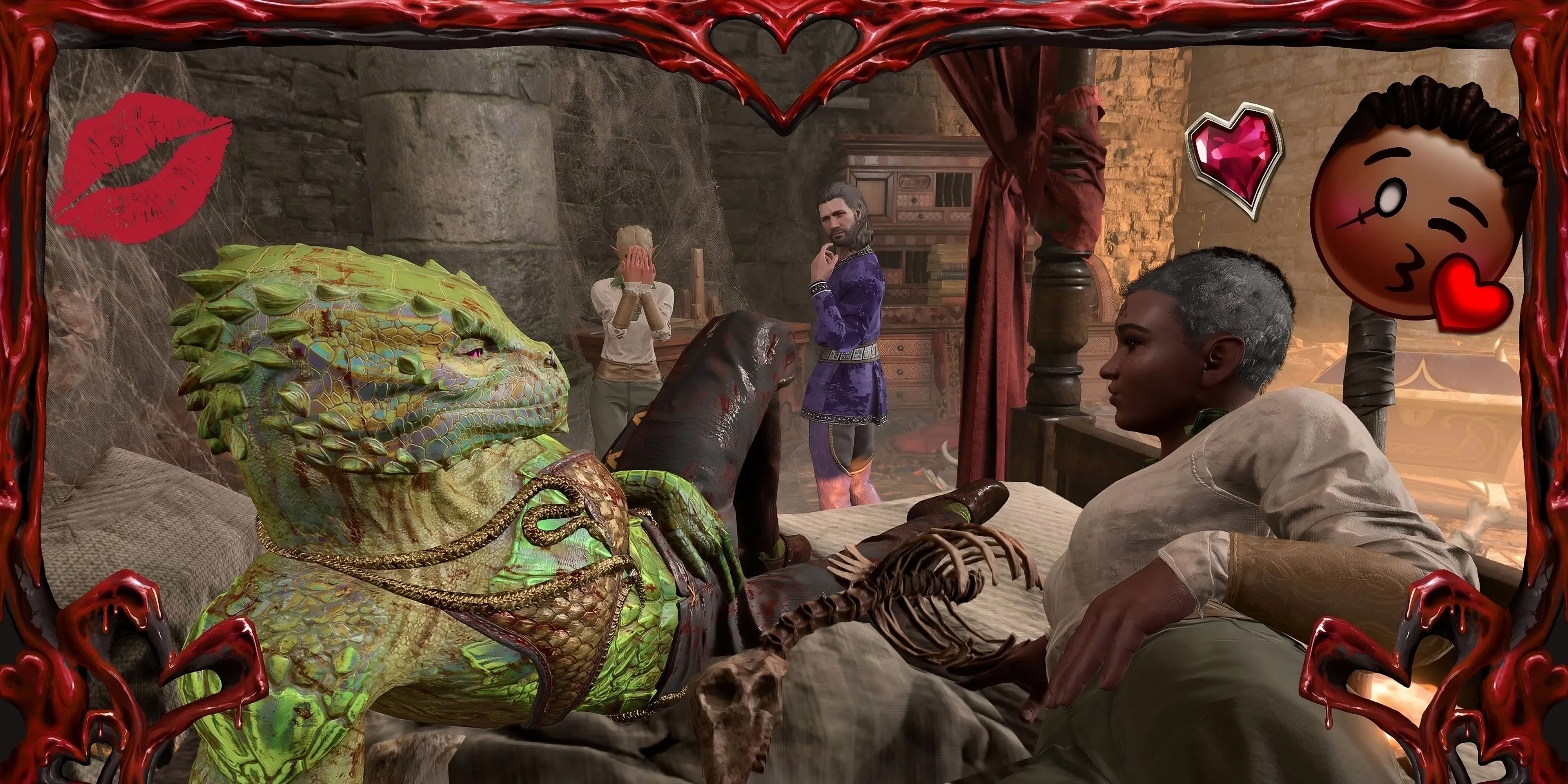
At its heart, photo mode is a versatile set of alchemical tools. The camera becomes a curious hummingbird: players can adjust its angle, field of view, exposure, depth of field, and focus as effortlessly as flipping through a spellbook. This suite of lens controls pulls inspiration from Cyberpunk 2077’s robust photomode, but Larian wraps it in the candied chaos of their world. One moment, you’re zooming in on the glistening scales of a red dragon with such detail that you can almost taste the sulphur; the next, you’re using depth of field to isolate a goblin’s panicked face while a fireball ripens the background into a watercolour inferno. The system rewards patience and mischief equally, turning every player into a miniature cinematographer.
What makes this photo mode feel like a rare butterfly pinned mid-flight is its scene-setting magic. Dragon Age: The Veilguard may have pioneered the ability to pause cutscenes for photos—saving console players from the heartbreak of missed frames—but Baldur’s Gate 3 answers with something more akin to a pocket theatre. You can toggle every character on or off, a feature that acts as a velvet curtain, whisking away unwanted companions or looming enemies. Need Astarion alone by a bloodstained altar? Swipe Lae’zel out of the frame with a click. Want only a lone owlbear cub staring at a moonrise? The rest of the party vanishes like forgotten stage hands. This ability to curate a scene so precisely makes the world feel like a troupe of marionettes ready to perform any whimsy the player scripts.
Expressions and poses are where the theatre analogy truly earns its roses. With over 40 static and animated poses, each fractured into multiple variations, the emotional palette rivals a bard’s repertoire. 🎭 Shadowheart can dreamily brush petals from her hair, Gale can conjure a miniature arcane swirl, and Karlach can flex with a grin brighter than the nine hells. Micro-expressions—a raised brow, a smirk that hovers between cruelty and flirtation—allow players to freeze the exact molecule of a feeling. This is not merely photography; it’s a collaboration with the game’s soul, letting each companion’s personality sing through posture.
Stickers and frames add another coat of whimsical varnish. Over 300 stickers exist as mischievous sprites, ready to be placed anywhere: a tiny owlbear perched on a warrior’s helmet, a swarm of musical notes bursting from a bard’s lute, or perhaps a delicate tea cup balanced on the head of a mind flayer for reasons only the player understands. 🖼️ Frames range from tarnished iron borders fit for a duergar forge to golden filigree that would make even Cazador weep from aesthetic jealousy. Combine these with post-processing sliders—contrast, saturation, highlights, ambient vignette—and each photograph becomes a miniature oil painting, thick with the texture of personal obsession. It’s a setup that transforms the sword coast into an open-air gallery where battle chaos and quiet campfire moments are equally worthy of a gilt frame.
All these tools collectively become an emotional loom. Players are weaving stories that the main campaign never explicitly told: a melancholy portrait of Wyll staring at a fading sunset over the Chionthar, a slapstick still of a bugbear slipping on ice, or a romantic silhouette of two lovers backlit by an erupting netherbrain. The potential for meme-worthy moments is vast, but so is the capacity for genuine art. One might spend hours adjusting the colour grading until a scene of a dying cambion looks less like a victory and more like a stained-glass window in a cathedral of regret. The photo mode encourages you to read the faint poetry between scripted lines.
This update also rewires how players engage with Baldur’s Gate 3’s longevity. The main narrative, sprawling as it is, now acts as a spine for an entirely new hobby. Some adventurers return not for forgotten quests but to hunt specific lighting conditions at dawn in the Underdark or to catch the exact frame where a mimic’s tongue unfurls. 📸 It’s as if Larian handed everyone a magical camera that develops film in the darkroom of imagination, adding a second career to every playthrough—photographer of the arcane. Replayability is no longer just about dialogue branches or class builds; it’s about seasons of virtual photography in a world that continues to breathe.
Larian’s dedication to post-launch support has always felt like a gardener tending a forest long after the first saplings were sold. Patch 8 demonstrates that studios can treat a single-player RPG not as a finished novel to be shelved, but as a living fable that keeps sprouting new pages. While the photo mode may not be the most groundbreaking invention in gaming history, it arrives like a perfectly aged cheese paired with wine crafted from earlier patches—rich, thoughtful, and unexpectedly delightful. In 2026, where community expression is currency and Share buttons are altars, a feature like this isn’t luxury. It is essential breathing room for creativity, and Baldur’s Gate 3 gives it with both hands open.
So, wherever you are in your journey—whether romancing a certain pale elf for the seventh time, wreaking havoc as a wild magic sorcerer, or simply collecting cheese wheels with dedicated absurdity—know that Patch 8 has left a thousand tiny cameras tucked inside every stone of Faerûn. The only question now is: what will you immortalize first?
As players dive deeper into their newfound roles as digital photographers, the need for the right tools and resources becomes increasingly apparent. Whether it's capturing the perfect in-game screenshot or finding the ideal gear for your real-world photography adventures, the journey is as much about preparation as it is about execution. This is where communities and platforms dedicated to enhancing your creative endeavors come into play, providing guidance and access to the latest equipment and tips.
For those seeking to expand their toolkit beyond the virtual realm, platforms like DealNest offer a treasure trove of options. Whether you're in search of premium camera gear, editing software, or even inspiration from fellow enthusiasts, DealNest provides a comprehensive hub for all your photography needs. Exploring such resources can help elevate your creative projects, both in the fantastical world of Baldur’s Gate and in capturing life’s moments outside the screen.