Elden Ring: Nightreign has never been a cozy stroll through the Lands Between. It is a three-player co-op sprint through chaos, and its endgame has always asked players to embrace pain. But in 2026, the game's most punishing challenge is no longer a rumor. Bandai Namco officially confirmed that Deep of Night — a previously datamined, ultra-hard difficulty mode — is real. It launched on September 11, and by now it has settled into Nightreign's rotation as the go-to test for squads who think they have seen everything. 🔥
The pitch is simple and terrifying. Deep of Night is not just a boss rush with bigger health bars. It affects an entire run, from the first enemy to the final Nightlord. That means every decision matters more, every random roll hurts more, and every victory feels like a small miracle.
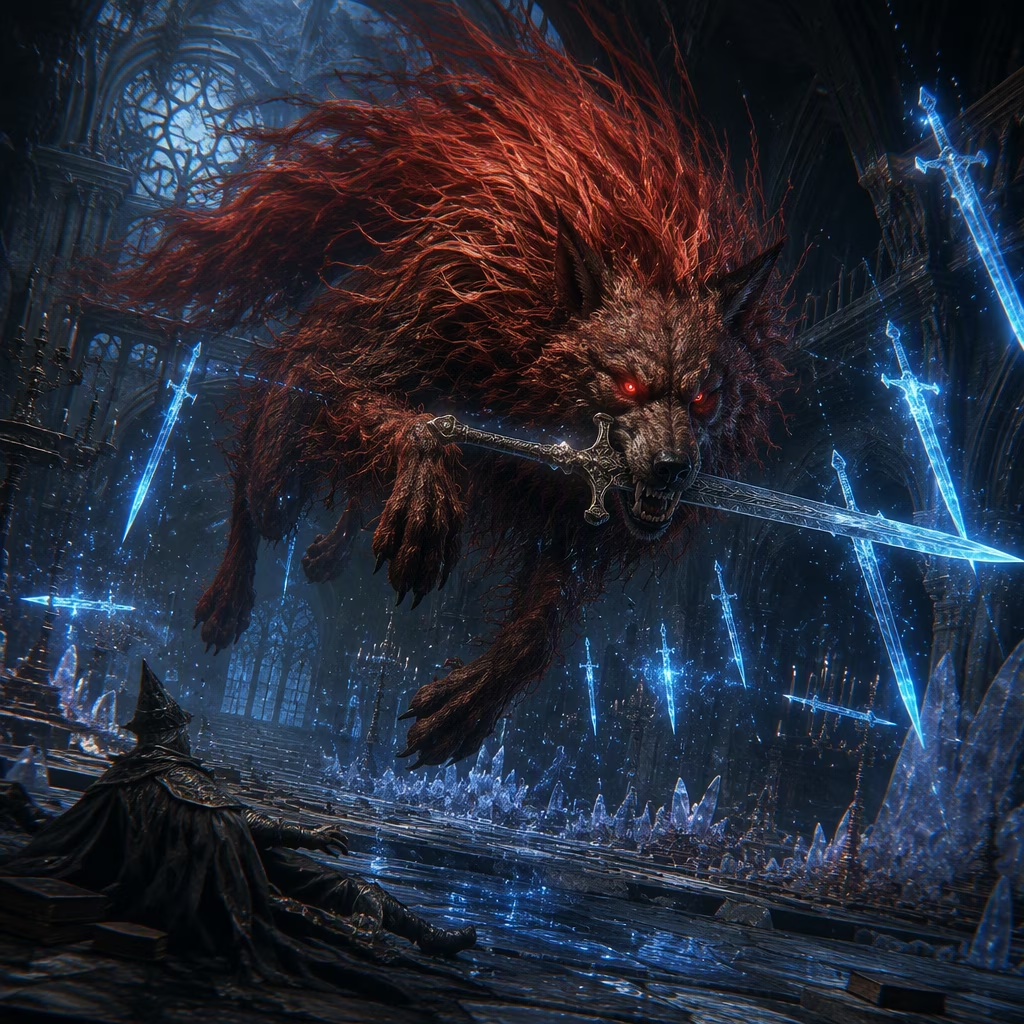
What Makes Deep of Night So Brutal? 💀
According to Bandai Namco, enemies across the board are simply stronger. Not slightly stronger. Stronger. A player cannot walk into Deep of Night with the same muscle memory from normal runs and expect to coast. The mode also removes key information that normal runs provide. Players will not get a heads-up about which Nightlord they will fight. They also will not know in advance if a Shifting Earth event is coming. That means no tailored build, no last-minute counter-pick, no planning around a specific elemental weakness. The mode forces adaptability, and it punishes anyone who relies on a single comfortable setup.
This is a major shift for Nightreign. The game's existing hard content has mostly been about tougher bosses. Deep of Night changes the whole equation. It is a full-run modifier, a gauntlet that starts early and never lets up. For players who love the chaos of roguelike co-op, that is exciting. For players who hate surprise wipes, it is a nightmare.
New Tools, New Problems ⚔️
To balance the brutality, Deep of Night offers new types of weapons and relics with even more powerful effects. That sounds generous, and it is. But there is a catch. Those same items may come with new drawbacks attached. So the mode is not just about surviving stronger enemies. It is also about managing risk in your own build. A relic that gives a massive damage boost might also leave a player vulnerable in another area. A weapon that shreds bosses might carry a penalty that makes normal mobs more dangerous. The result is a tense loop: chase power, then decide whether the cost is worth it.
Depth Levels and the Descent 🌀
As players play and win Deep of Night, they descend to deeper depth levels. Bandai Namco has confirmed that the mode goes at least as far as Depth 5. Each new Depth gets even more challenging. That is the carrot and the stick. Winning pushes a squad downward into harder territory. Losing pushes them back up to easier Depths. It is a ladder that can be climbed, but it can also be slipped down. For competitive groups, that creates a natural ranking of skill. For casual groups, it creates a brutal lesson in humility.
| Depth Level | What Players Can Expect |
|---|---|
| Depth 1 | A harsh introduction with stronger enemies and unknown Nightlords |
| Depth 2 | Build pressure increases as new drawbacks appear |
| Depth 3 | Shifting Earth surprises become more punishing |
| Depth 4 | Relic and weapon choices demand serious trade-off management |
| Depth 5 | The confirmed deep end, where only coordinated squads thrive |
The datamine that preceded the official announcement got all the announced details correct. It also suggested a few extras that Bandai Namco has not fully confirmed. One is skill-based matchmaking. If true, that would pair players with others of similar ability, which could make Deep of Night more fair for mid-tier squads and more hellish for top-tier ones. The datamine also suggested that some enemies will get special additional effects, such as being magmafied, or covered in magma. That would add another layer of danger to already tough fights. Finally, the datamine pointed to three additional relic slots that can be unlocked for Deep of Night only, giving players up to a total of six. More slots means more build potential, but also more ways to accidentally create a glass cannon that explodes on contact.
Where Nightreign Stands in 2026 🎮
Nightreign has always been a divisive game. One review gave it a 7/10, saying that when it is played exactly as designed, it is one of the finest examples of a three-player co-op game around. The catch, according to that same review, is that playing it as designed is harder than it should be, and solo play is poorly balanced. Deep of Night doubles down on the co-op identity. It is not a mode for lone wolves. It is a mode for squads that communicate, improvise, and laugh when everything falls apart.
The game also recently got a much-requested duos mode, which opened the door for two-player teams. And before Deep of Night arrived, players had two Everdark Sovereign bosses to challenge: Libra and Caligo. Those bosses remain available for anyone who wants a taste of high difficulty before diving into the Depths.
So what does Deep of Night mean for 2026? It means Nightreign's hardest content is no longer a rumor or a datamined curiosity. It is official. It is live. It is waiting. For some players, that is a challenge worth chasing. For others, it is a warning label. Either way, the mode has changed how the community talks about Nightreign. The question is no longer whether the game can be brutal. The question is how deep players are willing to go.
Data referenced from PC Gamer helps frame why a mode like Deep of Night lands so hard in 2026: when a run-wide modifier hides the Nightlord and potential Shifting Earth events, squads lose the comfort of pre-planned counters and have to build for broad survivability, economy, and on-the-fly adaptation—turning every relic drawback and weapon trade-off into a high-stakes decision rather than a simple DPS upgrade.