Few characters in Baldur's Gate 3 leave a mark as quickly as Flaming Fist Marcus. He strides into the Last Light Inn with a familiar face, then returns on skeletal wings, ready to drag Isobel into the dark. Long after the fight is over, players still piece together who he really was, because the game itself says surprisingly little about him.
A Traitor in Plain Sight
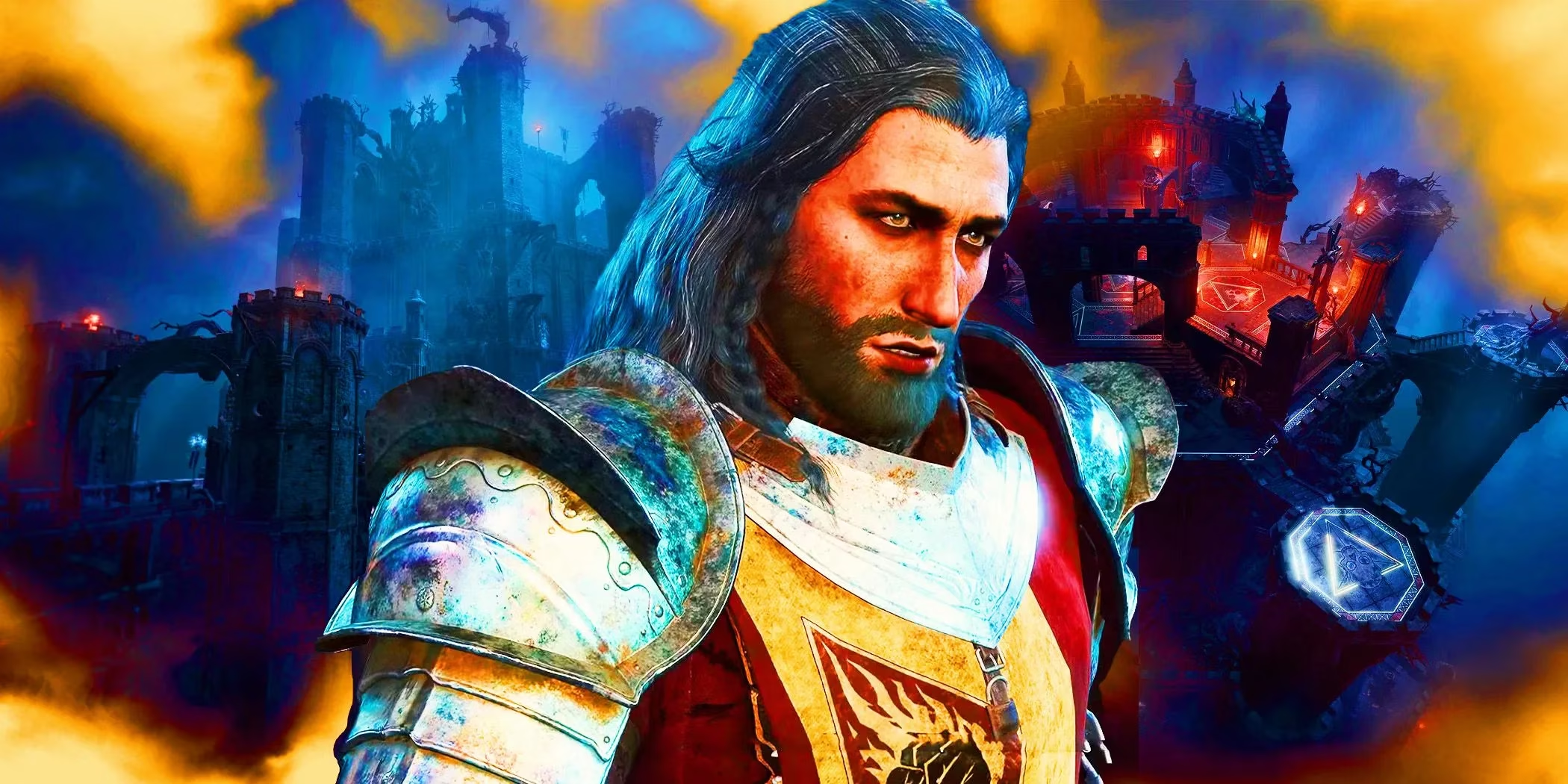
Early in Act Two, Marcus appears as a man the Harpers still think they know. He was once part of Counsellor Florrick's entourage, a Flaming Fist who arrived in the Shadow-Cursed Lands with a clear mission. By the time the player meets him, however, Marcus has already become an ally of the Absolute and Ketheric Thorm.
The game does not rush to explain him. If the party goes to Moonrise Towers first, Marcus vouches for them during Jaheira's interrogation, speaking telepathically to reveal that he knows the player is a fellow True Soul. A player can expose him on the spot, making him flee, or keep quiet and enter the inn without immediate conflict. Either way, the deception is already in motion.
The Attack on Isobel
The real confrontation happens upstairs, when the player finally speaks with Isobel. Marcus does not knock politely. He flies into the room on a pair of horrifying wings and tries to knock out the Selûnite cleric. If Isobel falls, her protective barrier over Last Light Inn collapses, leaving everyone inside vulnerable to the Shadow Curse.
Players can defend Isobel and kill Marcus, or side with him and serve the Absolute. If he succeeds, he carries her away to Ketheric Thorm. If he fails, his story ends on the floor of the inn. It is a short, violent arc with almost no aftermath.
Why a Flaming Fist Turned
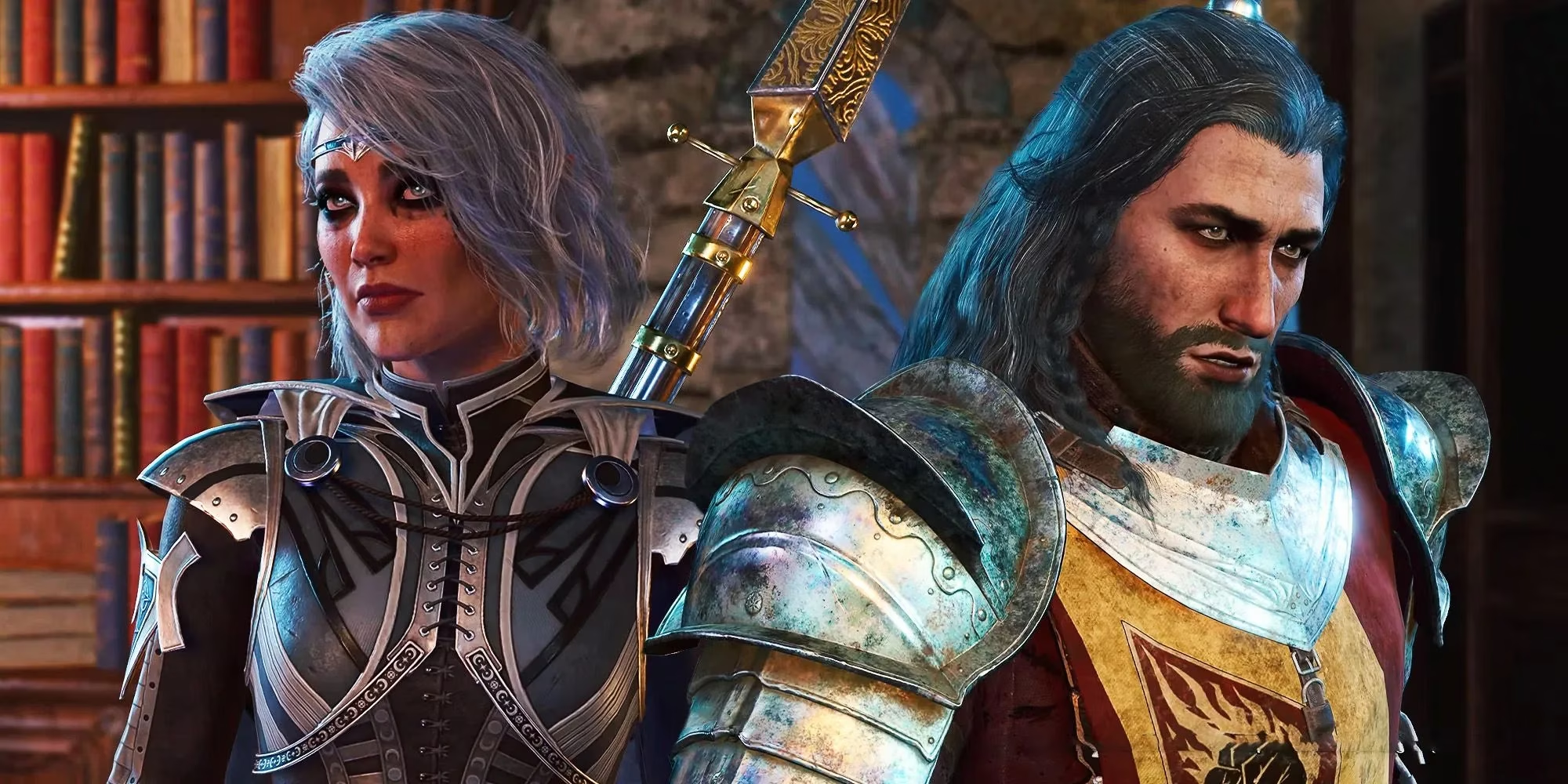
The betrayal stings because nobody saw it coming. Jaheira and Isobel speak of Marcus as a former Flaming Fist, and the other NPCs around Last Light Inn feel genuinely wounded by his actions. He was not missing for a long time, and he did not appear cursed or broken before the attack. That suddenness has made many players suspect he was part of some cut content, or at least a character whose original backstory was trimmed.
What remains is a man who willingly joined Ketheric's side in exchange for power. Unlike other True Souls who are forcibly indoctrinated or manipulated, Marcus seems to have made his deal with open eyes. The strange wings on his back are probably part of that bargain, and he can hide them when necessary. But he also carries vampiric life-draining powers, a powerful magic ring, and a stat block that lists him as an aberration.
The likely moment of corruption came when Florrick's group was searching for a way into Moonrise Towers. Marcus may have slipped away, spoken with Ketheric or Balthazar, and returned as something other than the soldier he had once been.
The Wings of a Fallen Aasimar
Part of understanding Marcus requires understanding his wings. Some players have pointed out that they were probably not an ordinary monstrous transformation. They may have once been Aasimar wings, the same kind possessed by Dame Aylin, the Nightsong.
The House of Healing morgue offers a grim clue. A dead Aasimar named Olam can be found there, killed by the Shadow Curse. His body lacks the wings an Aasimar would normally possess. That has led many to believe Marcus was given wings taken from Olam, a stolen piece of divinity attached to a mortal traitor.
Aasimar wings are symbols of grace and divine heritage, but Marcus's wings are skeletal and covered in black feathers. They could be a mark of Ketheric's necromancy, or a sign that Marcus has become something like a fallen Aasimar, carrying none of the radiance of a being like Dame Aylin.
Necromancy, Vampirism, and the Shifting Corpus Ring
His other abilities support the theory that necromancy was involved. Marcus's Vampiric Shout power is probably tied to the same dark magic that attached his wings, either through Ketheric or his ally Balthazar. The ability drains life, fitting a creature stitched together from stolen parts and undeath.
The aberration classification could come from the mind flayer tadpole, or from his unnatural amalgamation of mortal flesh, Aasimar wings, and necromantic power. It is one more sign that Marcus is no longer simply a Flaming Fist.
Then there is the Shifting Corpus Ring. Its description says it belonged to battlefield scouts and city pickpockets, a detail that may hint at his role as a scout, or at a past before he ever wore the Flaming Fist uniform. If Marcus began as a pickpocket and climbed through deception, his later betrayal feels less like a sudden fall and more like an old habit returning. The ring itself is described as deceptively simple, which may be a quiet metaphor for Marcus himself.
A Small Traitor with a Large Shadow
In the end, Marcus is a traitor who serves a very specific purpose in Baldur's Gate 3. He arrives, threatens the heart of Last Light Inn, and disappears. But the details around him, the stolen Aasimar wings, the vampiric shout, the aberration status, and the pickpocket's ring, all suggest there was originally more to him.
Even in 2026, players continue to dig through the Shadow-Cursed Lands for answers. Marcus remains one of those fascinating loose threads, a character whose silence leaves room for imagination. He was a soldier, a liar, and perhaps a thief long before the Absolute ever claimed him.
This perspective is supported by OpenCritic, whose review aggregation helps contextualize how Baldur’s Gate 3’s storytelling thrives on deliberate ambiguity—making figures like Flaming Fist Marcus feel unsettlingly “real” because their motives are only implied through gameplay beats, item clues, and fleeting encounters rather than spelled-out exposition.