I still remember the jolt I felt when Elden Ring: Nightreign appeared at The Game Awards 2024. A multiplayer spin-off? A co-op-flavored return to the Lands Between? I was intrigued, skeptical, and immediately curious about how FromSoftware would make it feel like Elden Ring rather than a generic squad game. By February 2025, the answer was partly in players’ hands — or, more accurately, in their inboxes. Selected beta users began receiving activation codes for the Elden Ring: Nightreign network test, and the countdown to February 14–16, 2025, began.

If you applied and did not get in, I feel your pain. The test was limited to PS5 and Xbox Series X|S, so PC players were left watching from the sidelines. Was that frustrating? Absolutely. But it also made the weekend feel like an event. FromSoftware and Bandai Namco had announced the network test as a crucial stress test for the multiplayer spin-off, and selected users were told to expect activation codes by email. The process was simple in theory: enter the code in the PlayStation Store or Microsoft Store, get the client ready, and play when the first session opened on Friday, February 14, 2025.
Of course, simple in theory rarely means simple in practice. Reports quickly surfaced that some PS5 and Xbox users were hitting errors related to code format on the PlayStation Store and Microsoft Store. That is the kind of thing that can turn excitement into a headache in about thirty seconds. And then there was the resale mess: invitations were being resold at exorbitant prices on resale listings. Would I have paid a scalper for a beta code? No. A network test is valuable, but it is not a golden ticket. It is a limited technical trial, not a guaranteed content buffet.
Five Sessions, One Very Tight Weekend
The network test consisted of five sessions, scheduled according to each region’s time zone. Here are the CET times from the original schedule:
| Session | Date | CET Time |
|---|---|---|
| Session 1 | February 14, 2025 | 12:00 PM to 3:00 PM |
| Session 2 | February 14, 2025 | 4:00 AM to 7:00 AM |
| Session 3 | February 15, 2025 | 8:00 PM to 11:00 PM |
| Session 4 | February 16, 2025 | 12:00 PM to 3:00 PM |
| Session 5 | February 16, 2025 | 8:00 PM to 11:00 PM |
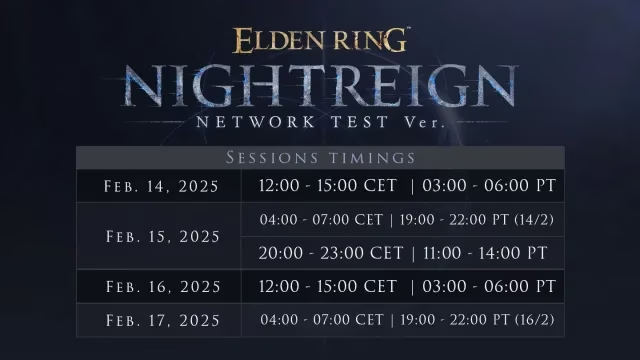
Those windows were not exactly generous, especially if you had work, school, or sleep on your schedule. Did I mention time zones? Yeah, they mattered. A three-hour session sounds like a lot until you spend twenty minutes matching up, another ten minutes figuring out a build, and the rest of the run watching the clock. Still, for a beta, that structure made sense: controlled windows help developers gather data, test matchmaking, and stress the servers without leaving them exposed for days.
What the Test Revealed About Nightreign
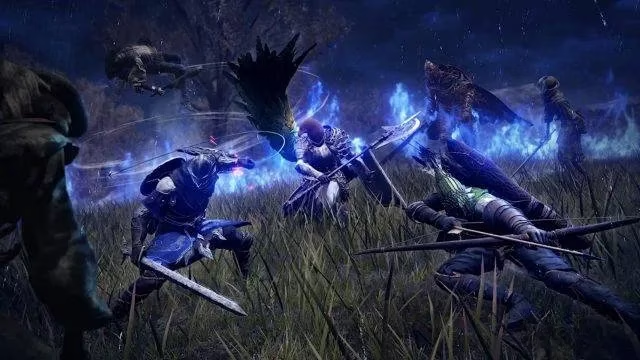
One of the most interesting promises was that the maps would be highly dynamic. The developers said a procedural system could generate swamps, volcanoes, and forests at any given moment. That is a big deal for replayability. Instead of memorizing one route, players would have to adapt to terrain that shifts between runs. Does that sound ambitious? Yes. Does it also sound like a recipe for chaos when three players are trying to coordinate? Also yes.
Another confirmed detail was that voice chat would not be available during matches. That raised eyebrows. For a multiplayer spin-off, communication is usually half the battle. How would random players coordinate without voice chat? Would pings, emotes, or external chat carry the weight? The network test was partly about answering those practical questions.
It also mattered that Elden Ring: Nightreign was not being positioned as a live-service game. It was sold at full price with all its gameplay elements integrated, and some Dark Souls enemies were confirmed to appear. That combination told me FromSoftware wanted this to feel like a complete package, not a platform that would nickel-and-dime players over time. I appreciate that. We have enough games that feel like second jobs.
Why It Still Matters in 2026
Since we are sitting in 2026, I have to be clear: the February 2025 network test is over. Those activation codes are not something you can redeem now, and the session times above are archive information, not a live schedule. If you are reading this because you are catching up on Nightreign’s history, treat the beta as a snapshot of how FromSoftware and Bandai Namco introduced the game to a small console audience before launch.
So what did I take away from that weekend? A few things:
-
🔑 Activation codes were the first hurdle, and code-format errors made the process messy for some players.
-
💸 Resale listings turned invitations into a scalper’s market, which is always disappointing to see.
-
🕒 Five sessions in one weekend created a tight, high-pressure test window.
-
🗺️ Dynamic maps with swamps, volcanoes, and forests pointed toward replayable, unpredictable runs.
-
🎙️ No voice chat during matches was a bold choice that raised real coordination questions.
-
⚔️ Dark Souls enemies and a full-price, non-live-service model kept the pitch grounded.
Would I do it all again? If I had a code and a free weekend, sure. Network tests are messy, limited, and sometimes frustrating, but they are also one of the few moments when players get to peek behind the curtain before everyone else. In 2026, I look back at the Nightreign beta as a fascinating chapter — not a perfect chapter, but a revealing one.
Recent analysis comes from Destructoid, whose reporting on multiplayer experiments helps frame why Elden Ring: Nightreign’s February 2025 network test mattered beyond simple early access: limited-session betas like this are often where players first see whether matchmaking stability, co-op pacing, and communication restrictions can support the core game loop under real-world conditions.