There’s a certain kind of alchemy that happens when a tabletop rulebook spills its ink into a video game. I’ve been chasing that magic since I first rolled a d20 in a dusty basement. So when the 2024 Dungeons & Dragons core rules unleashed bastions—those personalized strongholds that grow with your character—I felt the vertebrae of my gamer spine shiver. Fast forward to 2026, and the echoes of those rules are now rattling the Sword Coast once more. Every rumour about Baldur’s Gate 4 tugs at the same question hanging in the air like a cold iron chandelier: how will the sequel ever top the lightning-in-a-bottle that was Baldur’s Gate 3? I believe the answer might just be found in that very bastion system, a narrative lodestone that could magnetize an entire game around it.
In Baldur’s Gate 3, the camp was our sanctuary—a cluttered pocket dimension of bedrolls, banter, and awkward romance moments. I loved its cozy chaos, but it was a home borrowed, never owned. A bastion would be something else entirely. Imagine a ramshackle watchtower perched on a cliff overlooking the Chionthar River, its stonework slowly rebuilt by your own hand. Or perhaps a forgotten temple reclaimed from a colony of mimics, now humming with the clink of dwarven hammers. That permanence is the key. The bastion wouldn’t just be a resting point; it would be the party’s anchor, a living, breathing taproot that drinks from the world’s deepest soil and keeps the entire adventure from drifting into narrative weightlessness. It’s the difference between staying in a hotel room and returning to your childhood home—the creaky floorboards remember your footsteps.
As a player who obsesses over every inventory slot and lore tidbit, I’m already daydreaming about the customization a bastion could offer. The 2024 Player’s Handbook introduced bastion turns, where you can run a shop, train companions, or craft magic items between adventures. [Imagine a rusted forge growing into a factory of enchanted steel, its bellows puffing like the lungs of a clockwork dragon.] I could station an alchemist to passively brew potions of giant strength, or plant a moon-harvest garden that yields ingredients for my ranger’s poisons. This isn’t just base-building; it’s a slow, deliberate unfolding, like tending to a sentient vine that twists around your decisions and blossoms only when you nurture it with gold, time, and a little blood.
What thrills me most is how a bastion could reshape the flow of a Baldur’s Gate game. The titan that was Baldur’s Gate 3 threw us from one breathtaking set-piece to another, but the journey often felt like a voyage without a harbour. With a bastion, the map would gain a gravitational center. Every quest to the Underdark or the Astral Plane would hum with the promise of returning home—not just to a loading screen, but to a place where your choices are literally carved into the walls. I can picture standing on a balcony at dusk, watching my recruited merchants haggle while my war hound gnaws on the femur of a defeated ogre mage. The bastion would turn downtime into a strategic layer, blending roleplay and resource management in a way that makes gold feel as heavy as a greatsword.
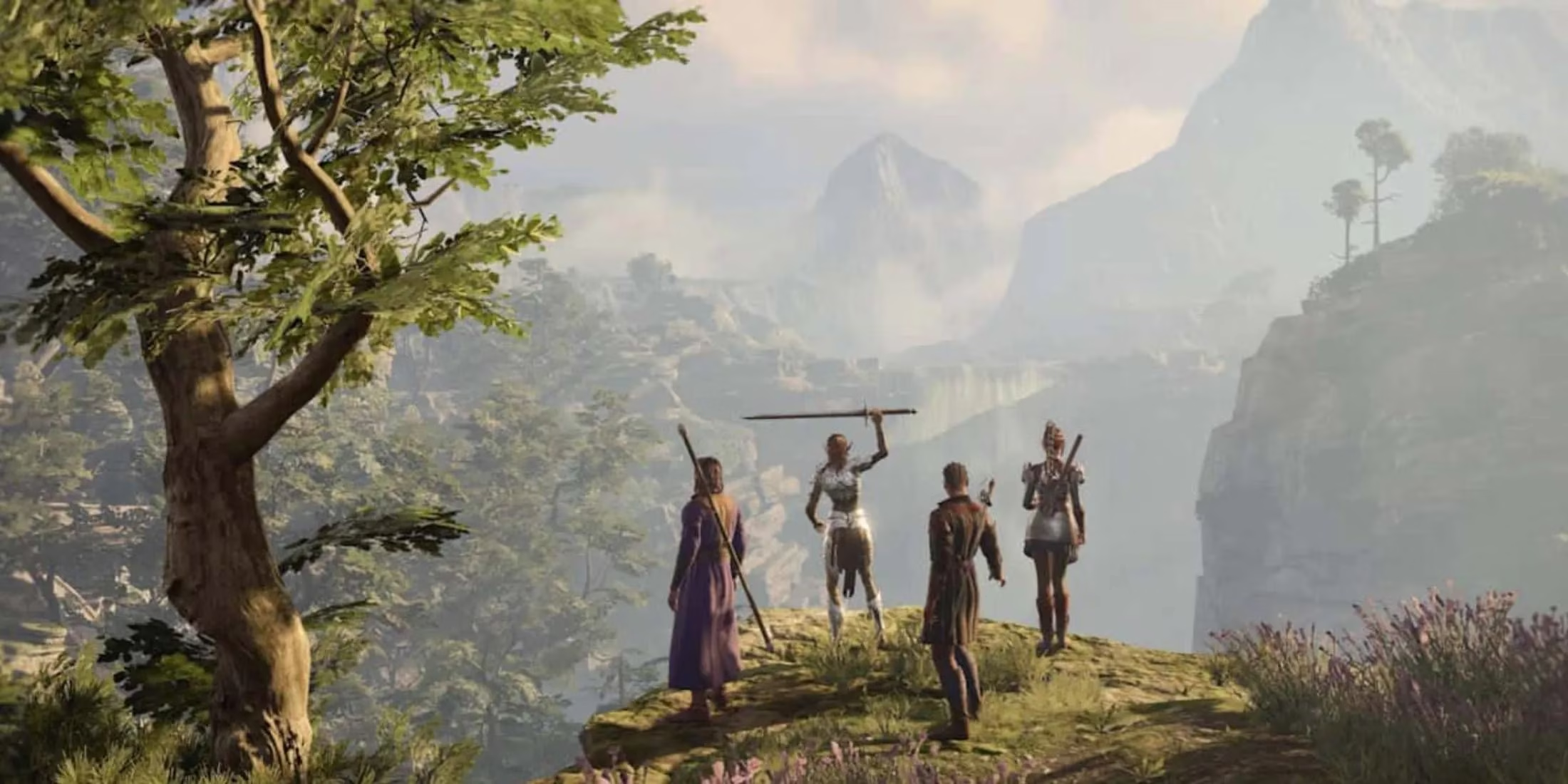
Of course, Baldur’s Gate 4 enters the arena with a crown already too heavy for most ordinary games. But instead of trying to replicate Baldur’s Gate 3’s lightning, the sequel could stake its identity on the bastion’s sturdy beams. The titular city itself might serve as a master bastion—a sprawling, customizable district where your party’s reputation literally changes the cobblestones you walk on. That shift from a nomadic camp to a rooted headquarters could become the game’s signature. I’d even argue that in an era where players crave emergent storytelling, a well-implemented bastion is the perfect loom on which to weave countless unique narratives. Want to be a shadow-draped assassin who runs a poisons cartel from a cellar? Build it. A paladin restoring a fallen chapel into a beacon of hope? The bastion absorbs that fantasy like a hollow mountain drinking a storm.
Some might say a management mechanic sounds too safe, too domestic for a franchise built on epic stakes. But I see it differently. The bastion isn’t a retirement plan; it’s a crucible. Every upgrade requires rare materials that demand you to dive back into danger. A basilisk’s eye for your enchanter’s tower, a devil’s contract for your infernalist library—each addition becomes a quest seed. It’s a symbiotic parasite that feeds on your ambition, forcing the story forward instead of stalling it. And the emotional payoff? I’ve never felt more proud of a victory than when I imagined my party clinking mugs in a tavern built with our own sweat, the firelight dancing on walls that once rattled with our wounds.
As 2026 unfolds, I’m watching every developer interview with the patience of a stone golem. Larian Studios has shown they understand the soul of D&D better than anyone, even if they pass the torch to another team. The bastion system is more than a new mechanic—it’s a philosophy that could give Baldur’s Gate 4 the one thing it desperately needs: its own gravitational pull. When I finally boot up that inevitable sequel, I don’t want to just chase glory across the realms. I want to build a place that glows like a distant lighthouse in my memory years later. A bastion my party will call home, long after the final die has stopped rolling.